
- No.
- 03
- To
- Buffer · signup flow
- From
- Phagwara
- Captured
- 19.10.2026
- Published
- 19.10.2026
- Revised
- 20.10.2026
- Region
- US
Ten changes to Buffer’s signup flow
Buffer’s signup flow, from the plan picker to the first form, marked up at desktop and phone widths: what a visitor chooses, and what reaches the form.
What a visitor chooses, and what reaches the form.
Not affiliated with Buffer
Want one for your page? A Teardown: US$950, 5 working days
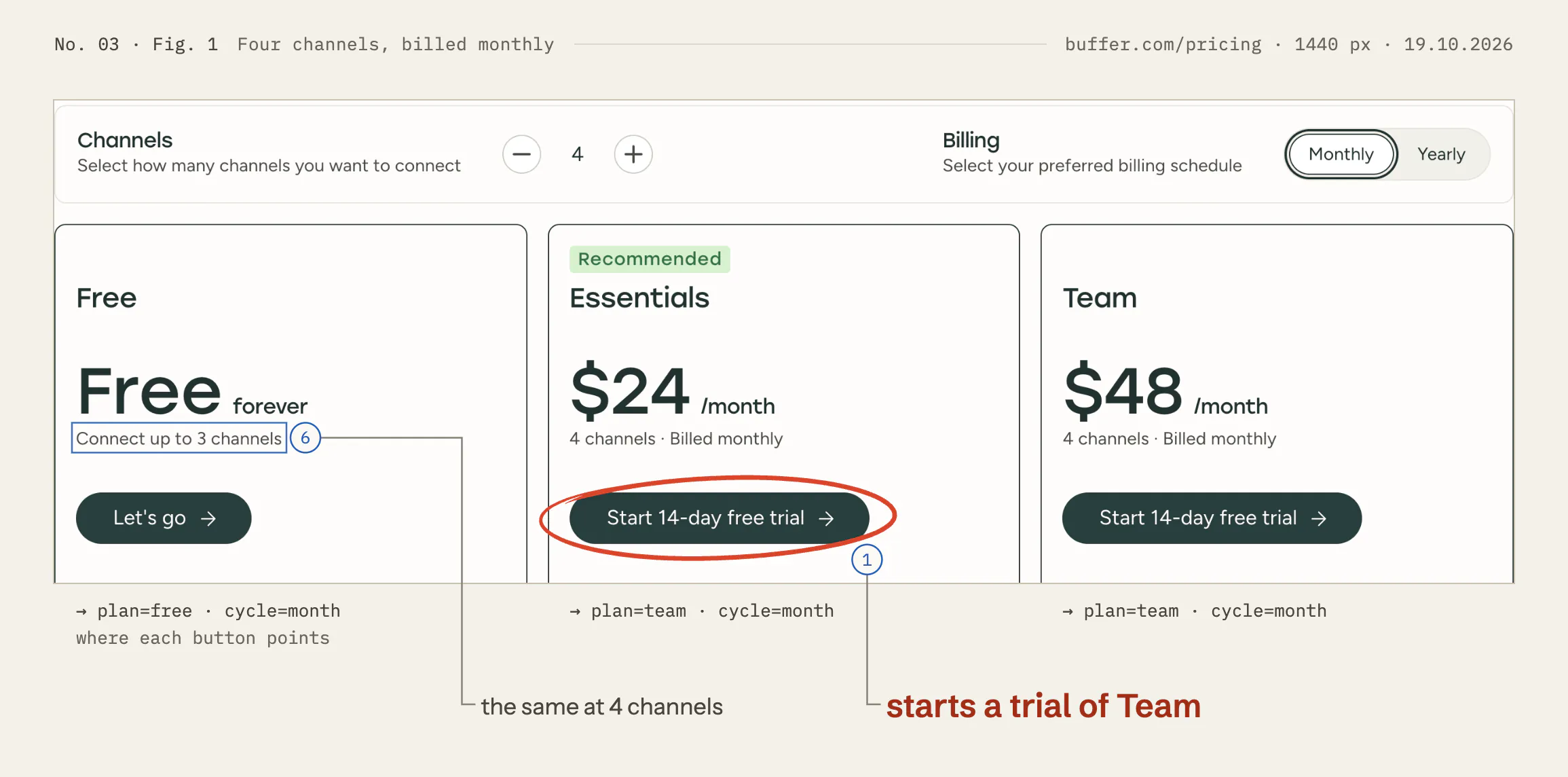
Four channels, billed monthly buffer.com/pricing · 1440 px · 19.10.2026
Changes 01: Say on the plan cards that every trial is a trial of Team 06: Let the Free plan’s card answer the stepper
Buffer is a social media scheduling tool from Buffer, Inc., a Delaware corporation based in San Francisco. It sells plans by the number of social channels you connect. Its signup starts on the pricing page: set the channels and billing, choose a plan, press its button, meet the first form. On Monday 19 October 2026 I followed it to the first form, at 1440 px and 390 px wide, and marked what I would change, in order.
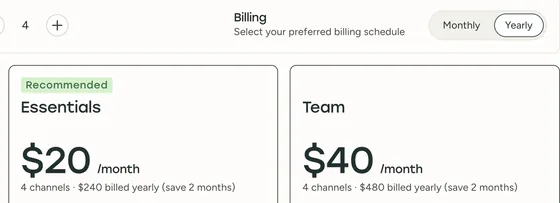
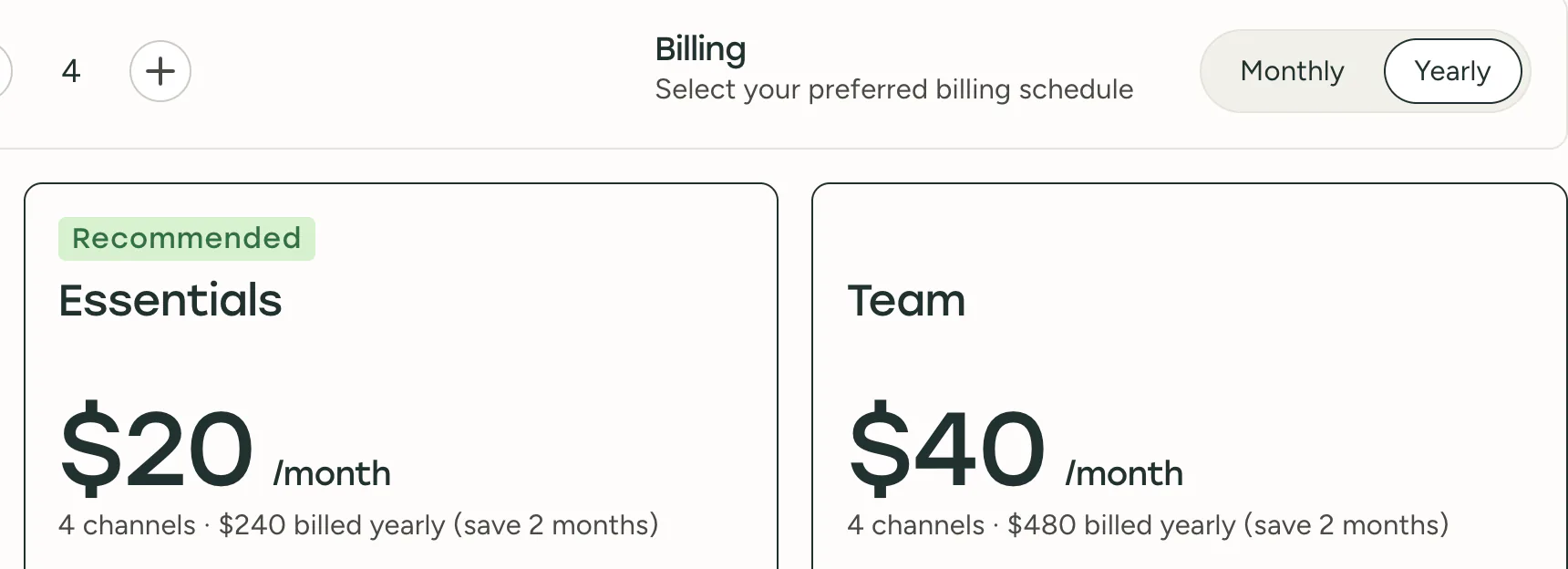
Much of it is good. Price has one unit, the channel, and the stepper re-prices both paid plans as it moves, showing the yearly amount too (“4 channels · $240 billed yearly”, in the inset under change 10). The FAQ is plain about a trial’s end, Buffer publishes a machine-readable copy of the page, and the form asks for two things and shows its password rules before you type. These changes are about the hand-off: how much of a visitor’s choice reaches the form.
Ten changes, in order
Say on the plan cards that every trial is a trial of Team
 Seen in Fig. 1. Show it on the figure.starts a trial of Team
Seen, why, try
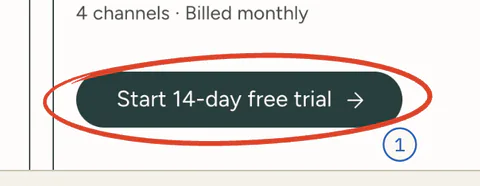
Seen. Essentials, marked “Recommended”, and Team each have a “Start 14‑day free trial” button, and both point to the same signup address, with plan=team in it (Fig. 1). Buffer’s help centre explains why: “When you start a trial, your account is placed on the Team plan.” I found no line on the pricing page that says so.
Why it matters. A visitor who picks the recommended plan spends fourteen days on a different one, with Team’s extras such as unlimited team members and approval workflows, and then has to choose again. That may be the right design for a trial. Not saying so means the plan tried is not the plan chosen, and the visitor learns it inside the product.
Try. One line between the switches and the cards: “Every trial is 14 days of Team, with every feature. When you add a card, you choose Essentials or Team.” Buffer’s help centre already says the plan can be changed at that step, in Billing. Essentials’ button can stay as it is.
Say “no card needed” where the trial starts
 Seen in Fig. 4. Show it on the figure.back to Free, no card
Seen, why, try
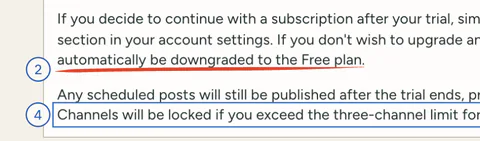
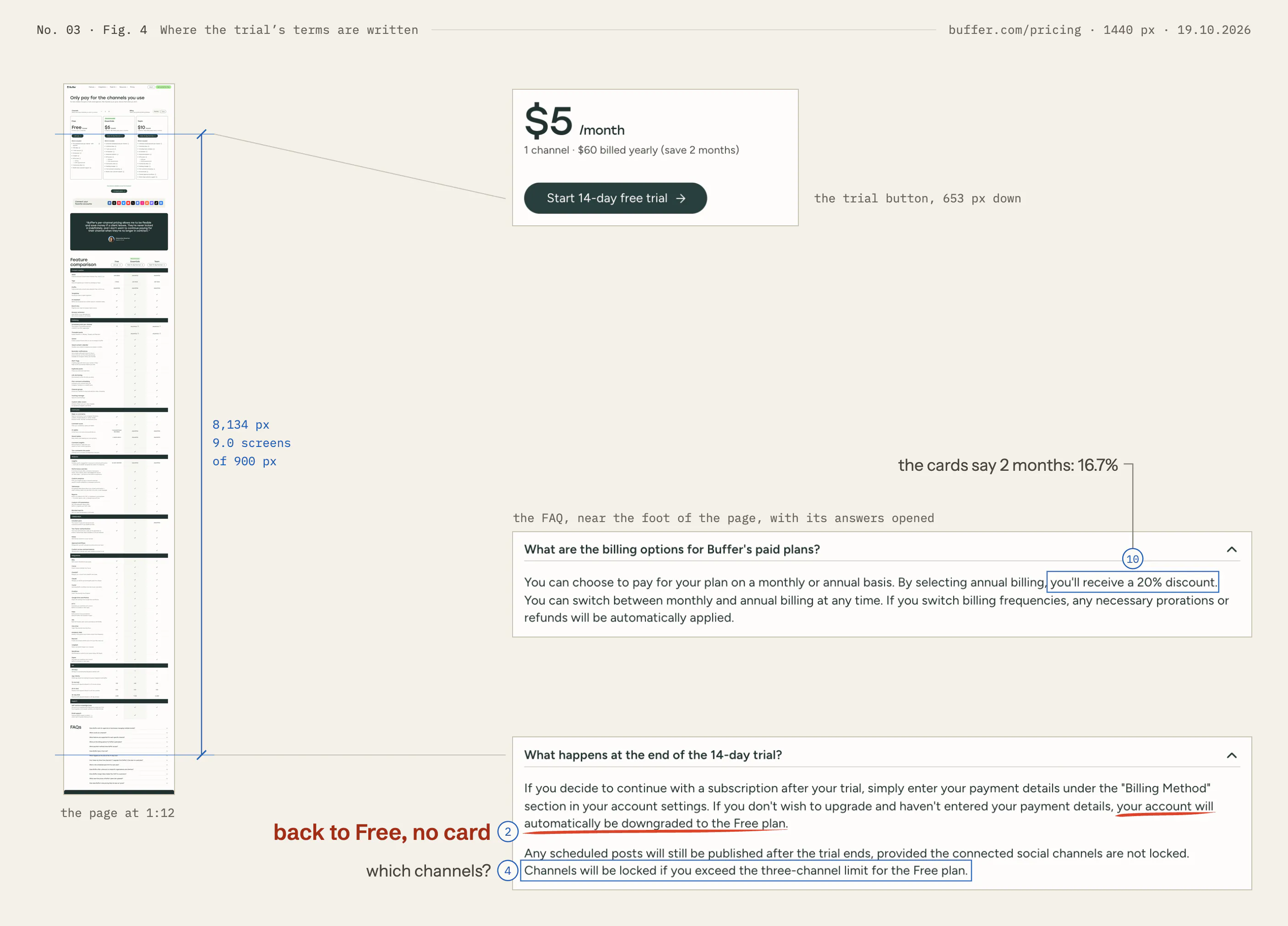
Seen. Neither the plan cards, nor their buttons, nor the form say whether a card is needed. The answer is in the FAQ, 8,134 px below the trial button and behind a click (Fig. 4): to carry on after the trial you “enter your payment details”, and if you have not, the account “will automatically be downgraded to the Free plan”. So a trial starts without a card, as the help centre also says.
Why it matters. “Do I need a card?” is one of the first questions at a trial button, and here the answer is the reassuring one. A visitor deciding at the button has to scroll about nine screens and open an answer to find it.
Try. Under each trial button, and once on the form: “No card needed. Without one, the trial ends on the Free plan.”
Let the form say what it is starting
 Seen in Fig. 2. Show it on the figure.no plan, price or trial
Seen, why, try
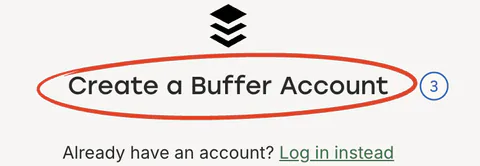
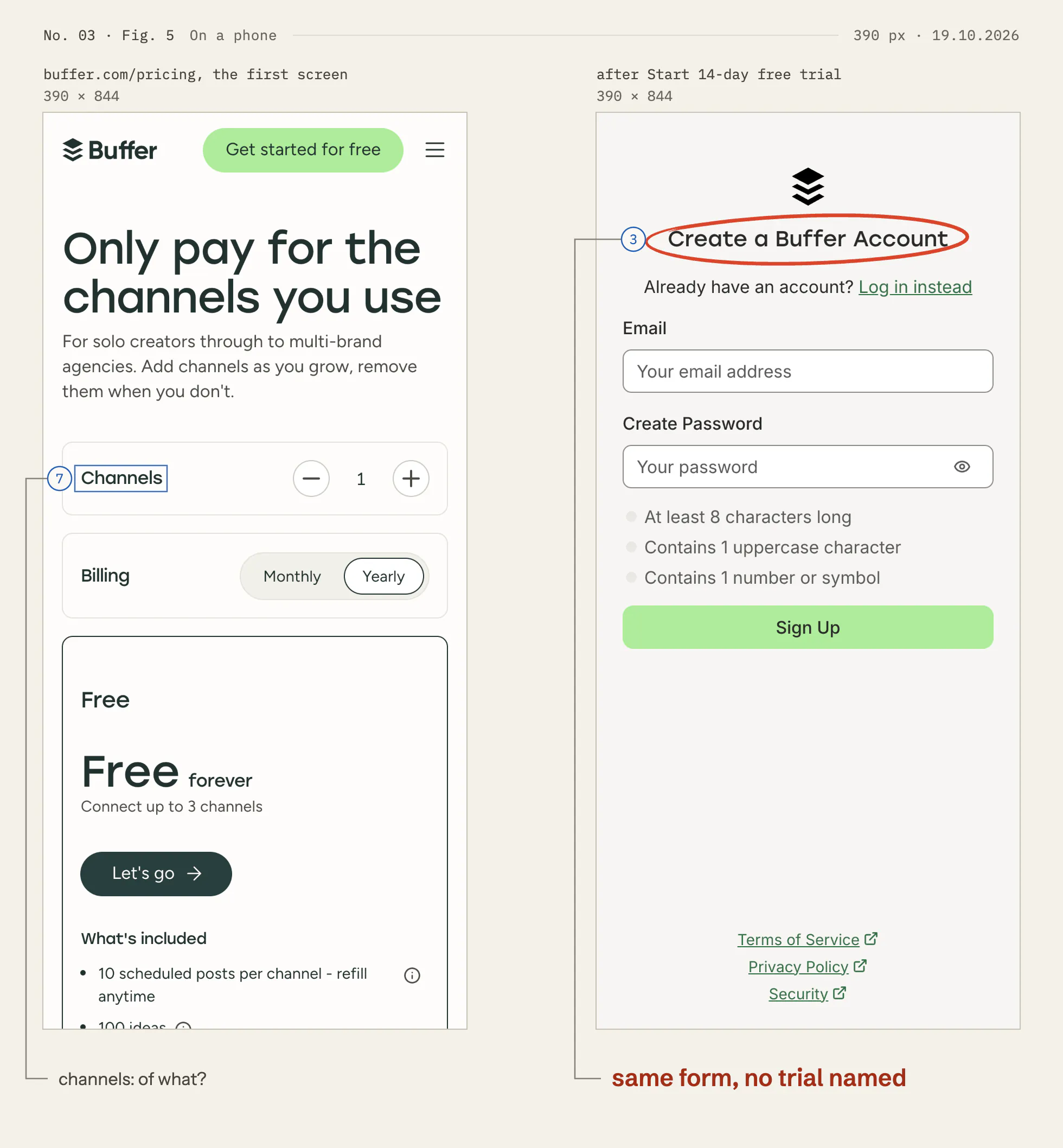
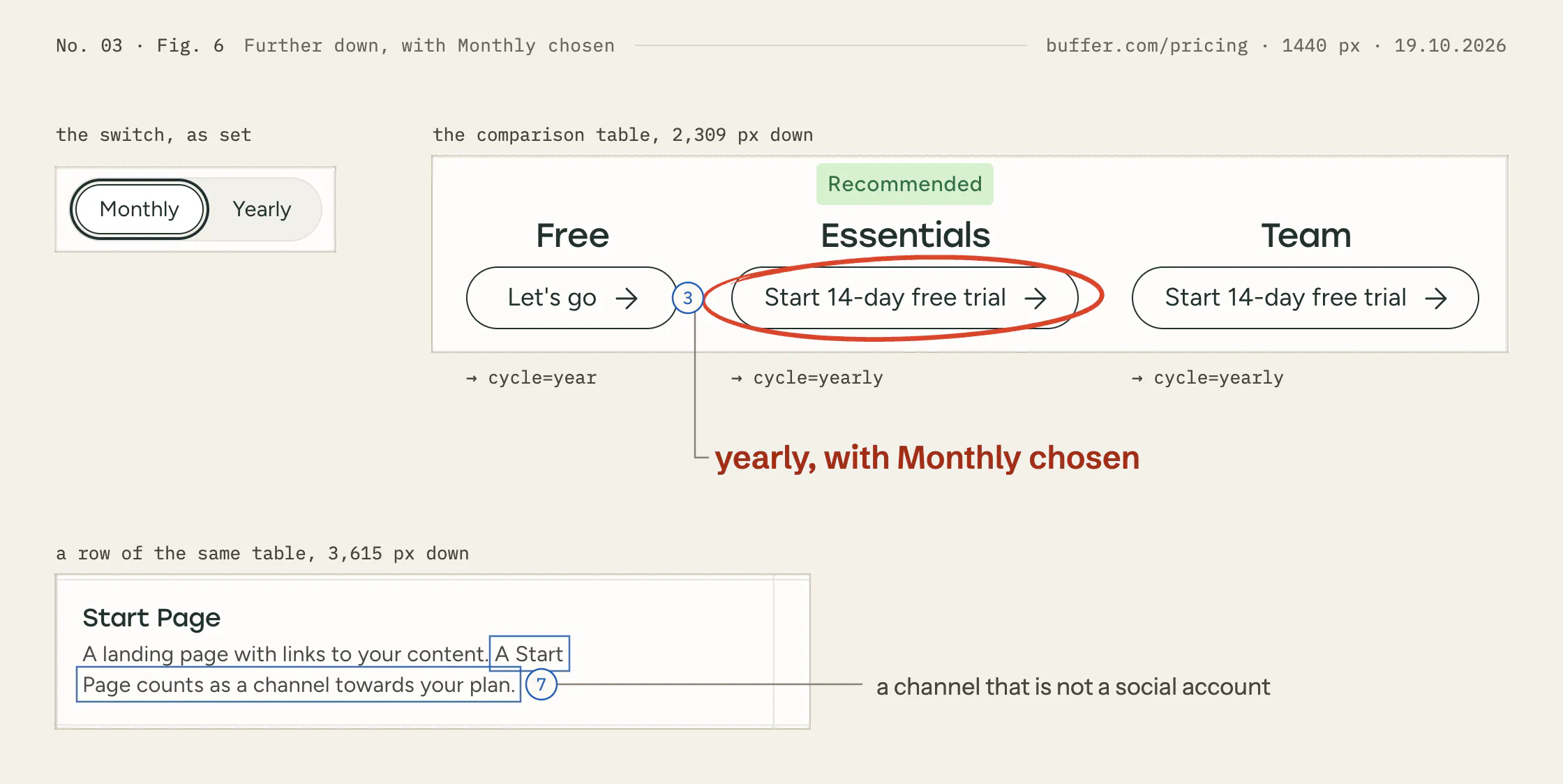
Seen. Essentials’ button, at 4 channels and Monthly ($24 a month, Fig. 1), opens “Create a Buffer Account”: email, password, “Sign Up”. Free’s “Let’s go” opens the same page; compared whole at twice the size, not one of 5,184,000 pixels differs (Fig. 2). Neither page says trial, plan, channel, card or price, even at 390 px (Fig. 5). The button’s address carries plan=team and cycle=month, not the channels; the table’s buttons send a yearly cycle even with Monthly chosen (Fig. 6).
Why it matters. The visitor has just made three choices: channels, billing and plan. The form gives no sign that any of them arrived, and someone starting a trial signs up on the same words as someone choosing Free.
Try. One line above the email field, written from the address the button already sends: “Start your 14‑day trial of Team. No card needed.” From a priced card, add what was chosen: “You picked Essentials, 4 channels: $24 a month if you stay.” That needs the channel count in the address, and the table’s buttons following the switch.
Say what happens to a fourth channel when the trial ends
 Seen in Fig. 4. Show it on the figure.which channels?
Seen, why, try
Seen. The stepper goes past three, and a trial ends on the Free plan unless a card is added. The FAQ says: “Channels will be locked if you exceed the three-channel limit for the Free plan.” (Fig. 4). Nothing near the stepper or the trial buttons says so, or which channels. The help centre does: with no choice made, Buffer locks the surplus itself; you can pick which stay active; and a locked channel’s queued posts wait until it is unlocked.
Why it matters. A trial user with four or more channels who does nothing by the last day finds some of them locked, with their queued posts on hold. Told at the start, it is a fact about the plan. Found at the end, it is a surprise, at the moment Buffer is asking them to pay.
Try. When the stepper is above three, one line under the trial buttons: “If you don’t add a card, the trial ends on Free, which keeps 3 channels. You choose which.” Link that line to the help centre’s answer on locked channels, which already exists.
Use the form page’s right half for the trial
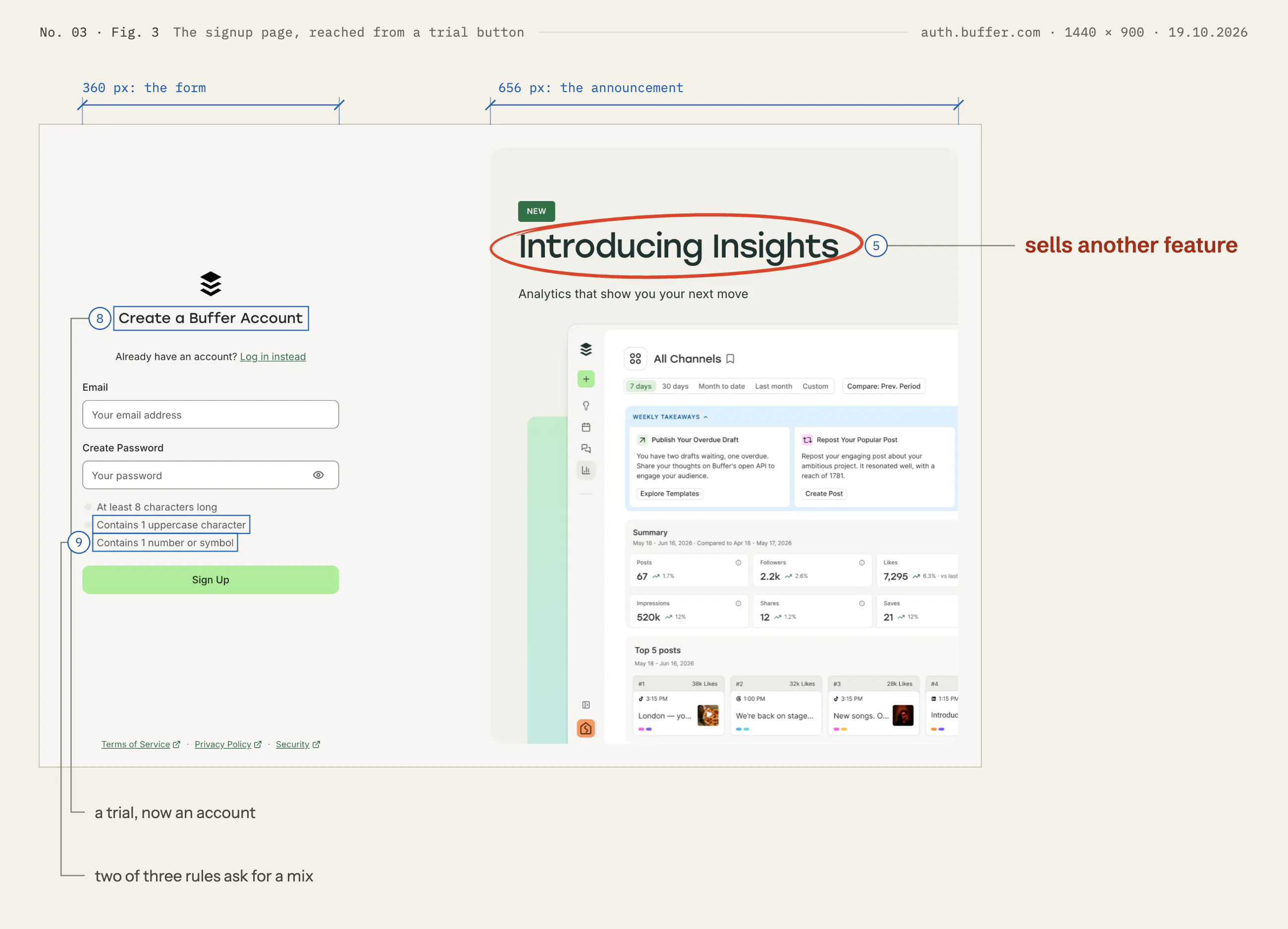
 Seen in Fig. 3. Show it on the figure.sells another feature
Seen, why, try
Seen. At 1440 px the form is 360 px wide. Beside it, a panel 656 px wide announces “Introducing Insights”, with a picture of the analytics screen (Fig. 3). The panel is the same after a trial button and after Free’s, and at 390 px it is not shown.
Why it matters. At the moment of signing up, the largest words on the page are about a feature the visitor did not ask about, while their own questions (which plan, until when, what then) have room and no answer.
Try. Use the panel for the trial: the plan being tried, its last day as a date, “No card needed”, and what happens at the end. The Insights announcement can wait for the first screen after signing in.
Let the Free plan’s card answer the stepper
 Seen in Fig. 1. Show it on the figure.the same at 4 channels
Seen, why, try
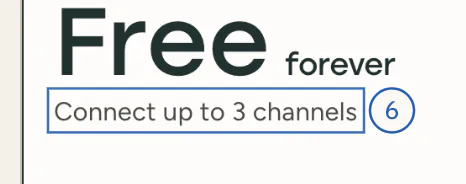
Seen. At four channels, Essentials and Team re-price (“4 channels · Billed monthly”), but Free still says “Connect up to 3 channels”, above the same “Let’s go” (Fig. 1).
Why it matters. The one card that cannot hold the visitor’s number is the only one that does not react to it, so it reads as if the choice made no difference to Free.
Try. Above three channels: “Free connects 3 of your 4 channels.” Keep the button: starting on Free with three is still a fair choice.
Say what a channel is, next to the stepper
 Seen in Fig. 5. Show it on the figure.channels: of what?rev. 20.10
Seen, why, try
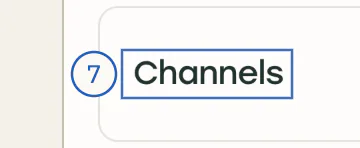
Seen. At 1440 px the stepper says “Select how many channels you want to connect”; at 390 px, only “Channels” (Fig. 5). The FAQ defines a channel as “one social account you connect to Buffer” (the inset), and a row of the comparison table, 3,615 px down, adds that a Start Page, a landing page, “counts as a channel towards your plan” (Fig. 6).
Why it matters. The channel is the unit of every price on the page, so the number in the stepper is only right if the visitor counts the way Buffer does, Start Page included.
Try. One line under the stepper, at every width: “One channel is one social account, such as an Instagram profile or a LinkedIn page. A Start Page counts as one too.”
 , open it full size
Inset The FAQ: what counts as a channel buffer.com/pricing · 1440 px · 19.10.2026 Keep the button’s words on the form
 Seen in Fig. 3. Show it on the figure.a trial, now an accountrev. 20.10
Seen, why, try
Seen. The card’s button says “Start 14‑day free trial”. The page it opens is titled “Buffer - Sign Up”, headed “Create a Buffer Account”, and its button says “Sign Up” (Fig. 3, with the title and the button’s address as read in the same session).
Why it matters. Three names for one step. The visitor looks for the thing they clicked and finds other words for it, and the heading is the cheapest place to confirm the choice.
Try. The trial button’s address already carries intent=start-trial, in its redirect. When it does, head the page “Start your 14‑day free trial” and label the button “Start my free trial”. From Free: “Create your free account”.
Read Read with the form, after a trial button auth.buffer.com/signup · 19.10.2026 - Page title
- Buffer - Sign Up
- Its button’s address, after redirect=
- https://publish.buffer.com/?intent=start-trial…
- Read
- 2026-10-19 07:28 UTC
Ask for a long password, not a mixed one
 Seen in Fig. 3. Show it on the figure.two of three rules ask for a mix
Seen, why, try
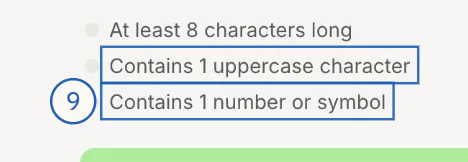
Seen. Under the password field, before anything is typed, three rules: “At least 8 characters long”, “Contains 1 uppercase character” and “Contains 1 number or symbol” (Fig. 3).
Why it matters. Two of the three are rules about a mix of characters. NIST’s current guidance on passwords (SP 800‑63B‑4, July 2025) says verifiers “SHALL NOT impose other composition rules”, and asks for length instead: at least 15 characters for a password used on its own, at least 8 when it is one factor of several. Each rule is one more thing to satisfy before the account exists.
Try. Drop the uppercase and number-or-symbol rules and ask for length, with the same live checklist, which is well made. Which minimum fits depends on how Buffer’s sign-in counts the password, and that is Buffer’s call.
Say the yearly saving one way
 Seen in Fig. 4. Show it on the figure.the cards say 2 months: 16.7%rev. 20.10
Seen, why, try
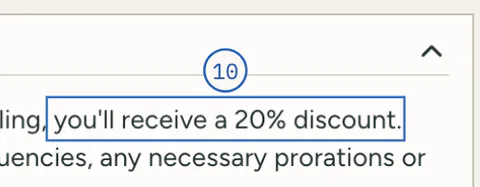
Seen. The cards say “(save 2 months)”. At four channels, Essentials is $240 billed yearly (the inset), against $24 a month, or $288 a year, billed monthly (Fig. 1). The FAQ says annual billing brings “a 20% discount” (Fig. 4).
Why it matters. $48 off $288 is 16.7%, which is two months in twelve, and Team’s $480 against $576 is the same. The 20% holds the other way round: billed monthly, the plan costs 20% more ($24 against $20). A careful buyer finds two figures for one saving, on a page otherwise exact about money, and the larger one is in the FAQ.
Try. One figure everywhere: “Save 2 months (about 17%)”, or change the FAQ’s 20% to match the cards.
 , open it full size
Inset Four channels, billed yearly buffer.com/pricing · 1440 px · 19.10.2026

(01)Figures
The flow, marked up
Each change is framed and carries its number from the list above; the one that matters most in each figure is ringed in red. Every blue figure was measured on the page itself. The labels in mono under some buttons are readings, not measurements: where the button points, read without following it. Fig. 1 and Fig. 6 show states set with the page’s own controls: four channels, billed monthly. Each figure opens full size.
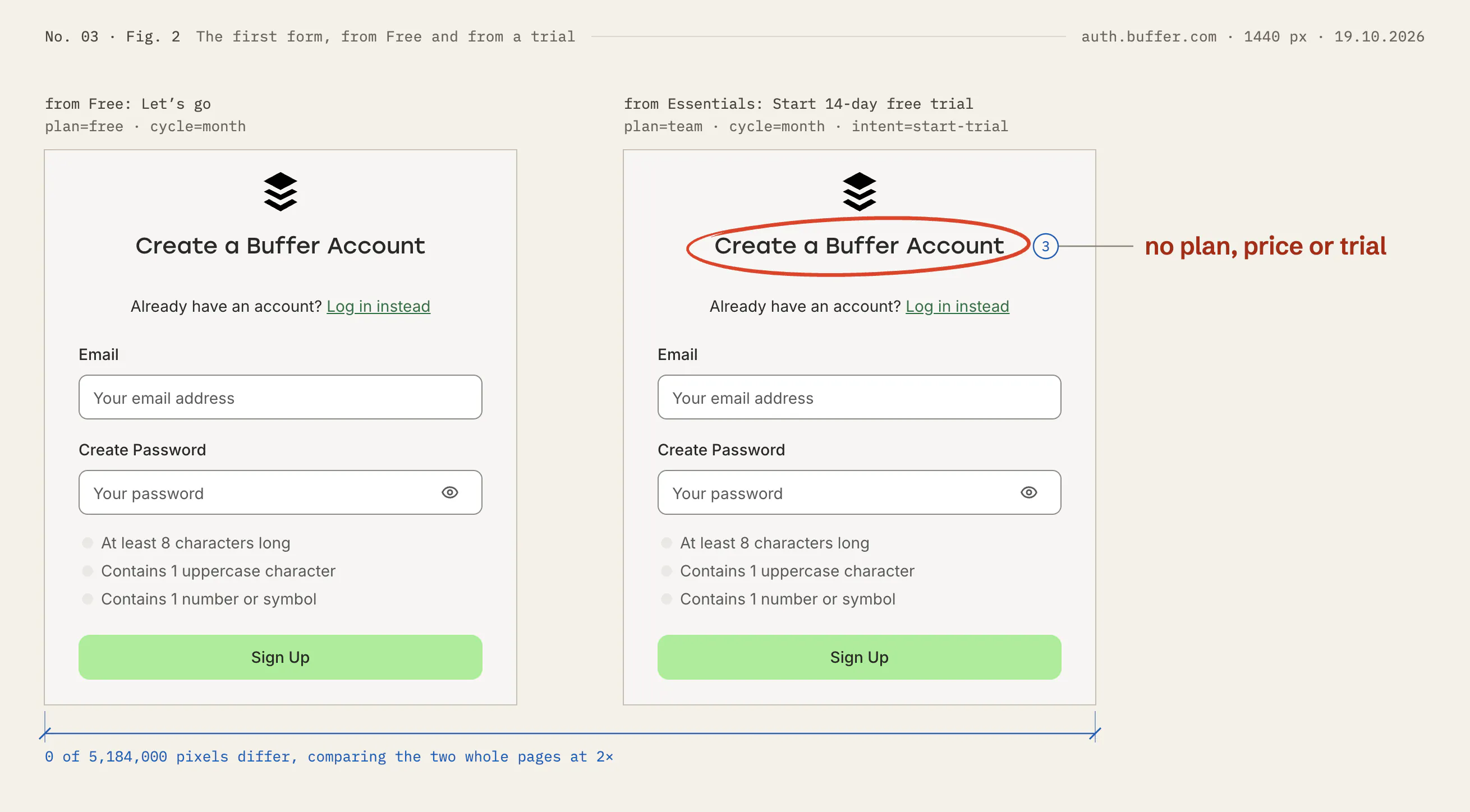
The first form, from Free and from a trial auth.buffer.com · 1440 px · 19.10.2026
Changes 03: Let the form say what it is starting
The signup page, reached from a trial button auth.buffer.com · 1440 × 900 · 19.10.2026
Changes 05: Use the form page’s right half for the trial 08: Keep the button’s words on the form 09: Ask for a long password, not a mixed one
Where the trial’s terms are written buffer.com/pricing · 1440 px · 19.10.2026
Changes 02: Say “no card needed” where the trial starts 04: Say what happens to a fourth channel when the trial ends 10: Say the yearly saving one way
On a phone 390 px · 19.10.2026
Changes 03: Let the form say what it is starting 07: Say what a channel is, next to the stepper
Further down, with Monthly chosen buffer.com/pricing · 1440 px · 19.10.2026
Changes 03: Let the form say what it is starting 07: Say what a channel is, next to the stepper
(02)TestsSuggested, not run
What I’d test first
The trial line (changes 1, 2 and 3). Show half of new visitors one line above the cards, “Every trial is 14 days of Team. No card needed”, repeated on the form; the other half sees today’s page. Measure the share of trial-button clicks that become new accounts and, once every trial in the test has ended, the share of those that add a card. Guardrail: new accounts from both buttons together. Agree beforehand the smallest change worth acting on, and run for at least two full weeks.
The password rules (change 9). They hardly need a test, because they take a step away. If you want a number all the same, watch how many people who start typing a password go on to press Sign Up.
(03)How it was readPublic pages only
Method and limits
- What I looked at. The public page buffer.com/pricing, and the signup form its buttons open (on auth.buffer.com, reached through login.buffer.com), as a visitor who was not signed in, on Monday 19 October 2026 between 07:00 and 07:29 UTC, from India. Prices were shown in US dollars. The same morning I read Buffer’s machine-readable pricing page and four help-centre articles: two on the trial and two on locked channels.
- How. Screenshots in headless Google Chrome at 1440 px wide, and at 390 px with a phone browser’s settings. A short script used the page’s own controls, as a visitor would: the stepper’s plus button three times, the Monthly switch, and four FAQ questions. Each button’s address was read, not followed; then Essentials’ trial address and Free’s were opened to see the form.
- Measured. Every position and distance from the page’s layout, in CSS pixels, and the two forms pixel by pixel at twice the size. The sums (12 × $24, $48 / $288, $24 / $20, 8,134 / 900) are mine.
- What I did not do. No account, no trial, no field filled in and nothing typed; Sign Up was never pressed, and I had no contact with Buffer. No consent banner appeared from India, so no consent choice was made.
- What I don’t know. What happens after Sign Up, beyond what Buffer’s FAQ and help centre say; Buffer’s traffic, conversion rates, test history or plans. The plan and the cycle in the addresses may be there for reasons the page does not show.
- Limits. The page differed between visits: across my loads its headline was either “Only pay for the channels you use” or “Flexible pricing for everyone”, which suggests a test, and every figure here shows the first. Visitors in other countries may see other prices or a consent banner. The figures show the pages as captured on the date above, not as they are today.
- Not affiliated. I have no connection with Buffer, and Buffer has not reviewed this. Buffer is a trademark of Buffer, Inc.
The record19.10.2026
- No.
- 03
- Subject
- Buffer
- Page or flow
- signup flow, buffer.com/pricing
- Region
- US
- Captured
- , at 1440 and 390 px
- Published
- Inside
- ten changes, in order · six figures · two insets
Public pages only, as seen on the date. Not affiliated with Buffer.
Revisions
- 07 Inset added, from the 19 October capture.
- 08 Inset added: the form’s own button, with the page’s title and the trial button’s address as read on 19 October. The button is in Fig. 2 and Fig. 3, so the inset now keeps only what was read with it.
- 10 Inset added, from the 19 October capture: four channels, billed yearly.
- Figures Their note said each figure was ringed in ember and its measures cyan; the plates print red rings and blue measures, so it now says red and blue, and that the list of changes comes first.
Sources
- Buffer, “Pricing”, buffer.com/pricing, read on 19 October 2026, with its FAQ answers on channels, billing, the free trial and the end of the trial, and the signup pages its buttons open.
- Buffer, “Buffer Pricing”, the page’s machine-readable copy, buffer.com/pricing.md, read on 19 October 2026: the same FAQ wording, including “a 20% discount”, and under its table of example costs, “Yearly billing saves approximately 2 months”.
- Buffer Help Center, “Information about free trials”, support.buffer.com, read on 19 October 2026: the trial is one per account, and it ends on the Free plan unless card details are entered.
- Buffer Help Center, “Buffer pricing and features”, support.buffer.com, read on 19 October 2026: “When you start a trial, your account is placed on the Team plan.”
- Buffer, “Legal”, buffer.com/legal, read on 19 October 2026: the service is offered by Buffer, Inc., of San Francisco, a Delaware corporation.
- NIST, Special Publication 800‑63B‑4, “Digital Identity Guidelines: Authentication and Authenticator Management”, July 2025, section 3.1.1.2, pages.nist.gov, read on 19 October 2026.
- Buffer Help Center, “What happens when you downgrade to the Free plan”, support.buffer.com, read on 19 October 2026: the three-channel limit, and surplus channels locked automatically when no choice is made.
- Buffer Help Center, “Unlocking a locked channel in Buffer”, support.buffer.com, read on 19 October 2026: choosing which channels stay active, and queued posts that “won’t publish until the channel is unlocked”.