Studio · AI features
A PRD for an AI feature
What a PRD for an AI feature adds to an ordinary one: worked examples, what it must never do, its failures, the test bar, the cost, and the model’s date.

Why an AI feature needs more
An ordinary feature does what its spec says, every time. An AI feature does it most of the time, and whether “most” is good enough depends on the user: Google’s People + AI Guidebook notes that a recommender useful 60% of the time can read as a success or a failure (source 2). Microsoft’s guidelines for
The ten sections
- The job and the decision. What the feature is for, in your users’ words, and what this PRD asks the team to decide.
- Worked examples. Five to ten real-looking inputs, each with the output a colleague would call good.
- What it must never do. The requests it refuses or hands to a person, and the words it uses when it does.
- What it can see. Its inputs, its context, the tools it may call, and any personal data: where each comes from and how long it is kept.
- When it is wrong. What the user sees, and how they correct it, undo it or take over.
- The test set and the bar. The cases, how each is graded, and what blocks launch, written before the first run.
- Cost and limits. The model cost per active user at the median, 90th and 99th percentile, the limit, and what happens at it.
- The model and its date. The model’s exact name, its retirement date, and the rule that any change
re-runs the test set. - Launch and what to watch. Who gets it first, the measures after launch, and how to switch it off.
- Open questions, each with an owner and a date.
Write the examples first
“Works well” can’t be checked. Anthropic’s guide asks for success criteria that are specific, measurable, achievable and relevant, and lists more to consider than how well the task is done: consistency, tone, privacy, latency and price among them (source 1). Worked examples are the quickest way to make them specific, and each one becomes a row in the starter test set.
Design the wrong answer too
The Guidebook’s advice for a failure is a path forward, and often the easiest is to let the user take over (source 2). Five of Microsoft’s 18 guidelines are for when the system is wrong, among them “support efficient correction” and “scope services when in doubt” (source 3).
So for every refusal and every harmful miss in the test set, the PRD names what the user sees: a question back, a handover to a person, or an undo.
Say it is an AI
If the feature talks to people in the EU, Article 50(1) of the AI Act asks its provider to make sure they are told they are dealing with an AI system, unless that is obvious from the context. It has applied since 2 August 2026 (sources 4 and 5). Write the wording into section 3 or 5, not into a ticket in launch week.
Give the model a date
Models retire, and requests to a retired one fail. Anthropic gives at least 60 days’ notice for a publicly released model: on 30 September 2026 it gave notice that Claude Sonnet 4.5 would retire on 30 November 2026 (source 6). OpenAI’s minimum for generally available models is six months (source 7).
So section 8 holds the model’s exact name and its date, and the rule that a new model or a new prompt runs the whole test set before it ships. Tokens change with the model too: same words, more tokens.
Cost is a requirement
Anthropic lists price among the success criteria, beside how well the task is done (source 1). Section 7 gives the budget per active user and the limit, from the four numbers, and says how the feature is charged for: in the seat, as credits, or per use.
What to watch after launch
- Edits, undos and dismissals: how often users correct or ignore the output.
- Handovers and refusals, against the share you expected.
- Cost per active user at the 90th and 99th percentile, not only the average.
- Every reported failure, written up as a test case before it is fixed.
Two of Microsoft’s guidelines for use over time belong here too: “encourage granular feedback” and “notify users about changes” (source 3).
The template
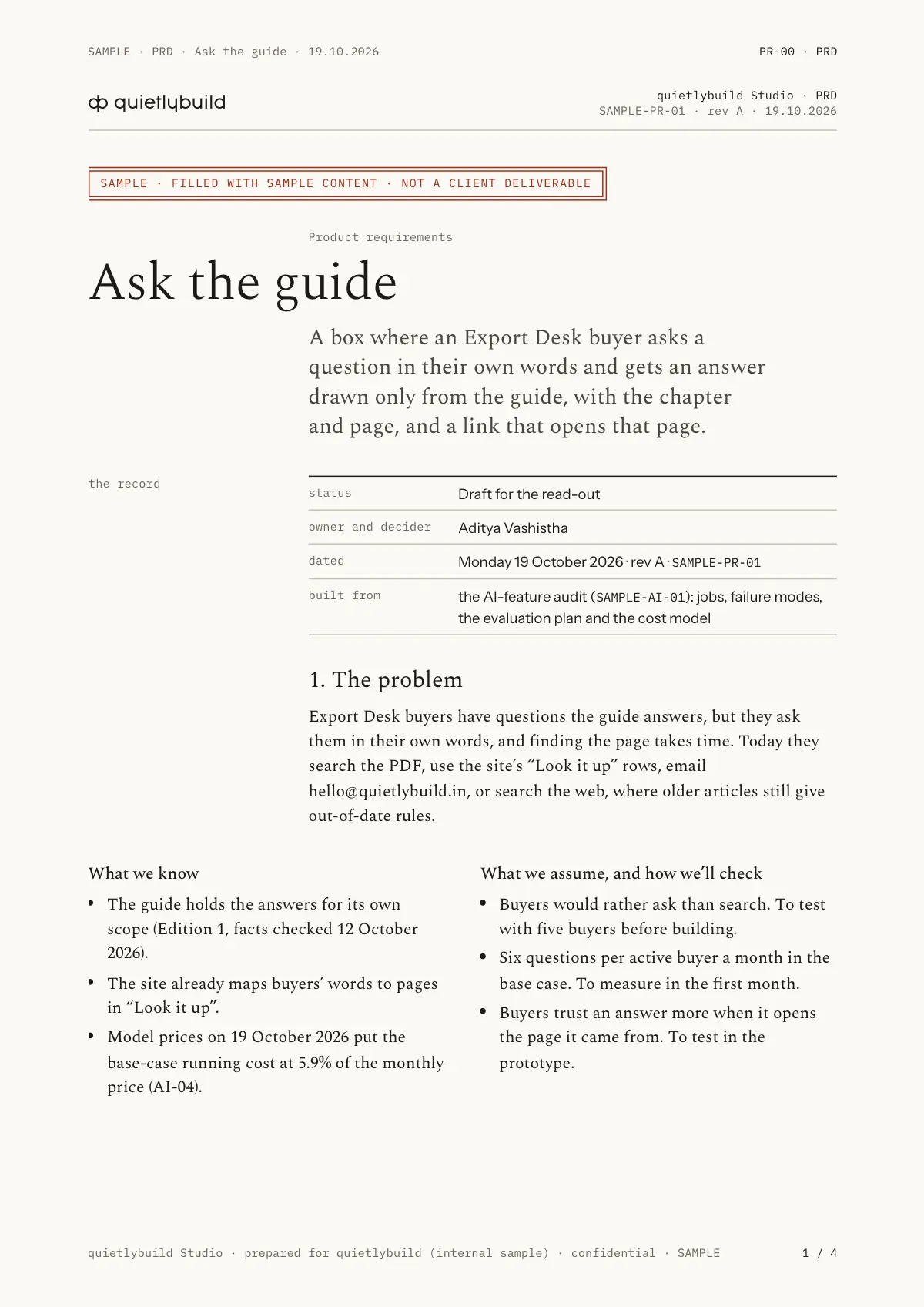
Download the PRD template (Markdown). It opens in any text editor and pastes into a doc or a repository as headings: the ten sections, a few prompts under each, the seven AI parts marked, and no sample feature to delete.
When it has to hold up
The
Sources
- Anthropic, “Define success criteria and build evaluations”, platform.claude.com/docs/en/test-and-evaluate/develop-tests, read on 25 October 2026: specific, measurable, achievable and relevant criteria, and the common criteria, price and latency among them.
- Google PAIR, People + AI Guidebook, “Errors + Graceful Failure”, pair.withgoogle.com/chapter/errors-failing, read on 25 October 2026: errors and expectations, the 60% example, and paths forward. The chapter shows no date.
- Saleema Amershi, Mihaela Vorvoreanu and Eric Horvitz, “Guidelines for
human-AI interaction design”, Microsoft Research blog, microsoft.com/en-us/research, 1 February 2019, read on 25 October 2026: the 18 guidelines of the CHI 2019 paper, in four groups. - European Commission, AI Act Service Desk, “Article 50: Transparency obligations for providers and deployers of certain AI systems”, ai-act-service-desk.ec.europa.eu, consolidated text as at 27 July 2026, read on 25 October 2026: paragraph 1.
- European Commission, AI Act Service Desk, “Article 113: Entry into force and application”, ai-act-service-desk.ec.europa.eu, read on 25 October 2026: the Regulation applies from 2 August 2026, and Chapter IV, which holds Article 50, is not among the exceptions.
- Anthropic, “Model deprecations”, platform.claude.com/docs/en/about-claude/model-deprecations, read on 25 October 2026: the notice period, and the retirement of Claude Sonnet 4.5.
- OpenAI, “Deprecations”, developers.openai.com, read on 25 October 2026: the minimum notice periods.
Not affiliated with any organisation named here. The AI Act section is general information, not legal advice.
What changed in this guide
- 25 October 2026. Written, with the template.