
- No.
- 06
- To
- Intercom · pricing page
- From
- Phagwara
- Captured
- 12.11.2026
- Published
- 12.11.2026
- Region
- US
Ten changes to Intercom’s pricing page
Intercom’s pricing page, in both versions it served on 12 November 2026: where a buyer has to work out what an AI outcome costs, and what I would change.
Where a buyer has to work out what an AI outcome costs.
Not affiliated with Intercom
Want one for your page? A Teardown: US$950, 5 working days
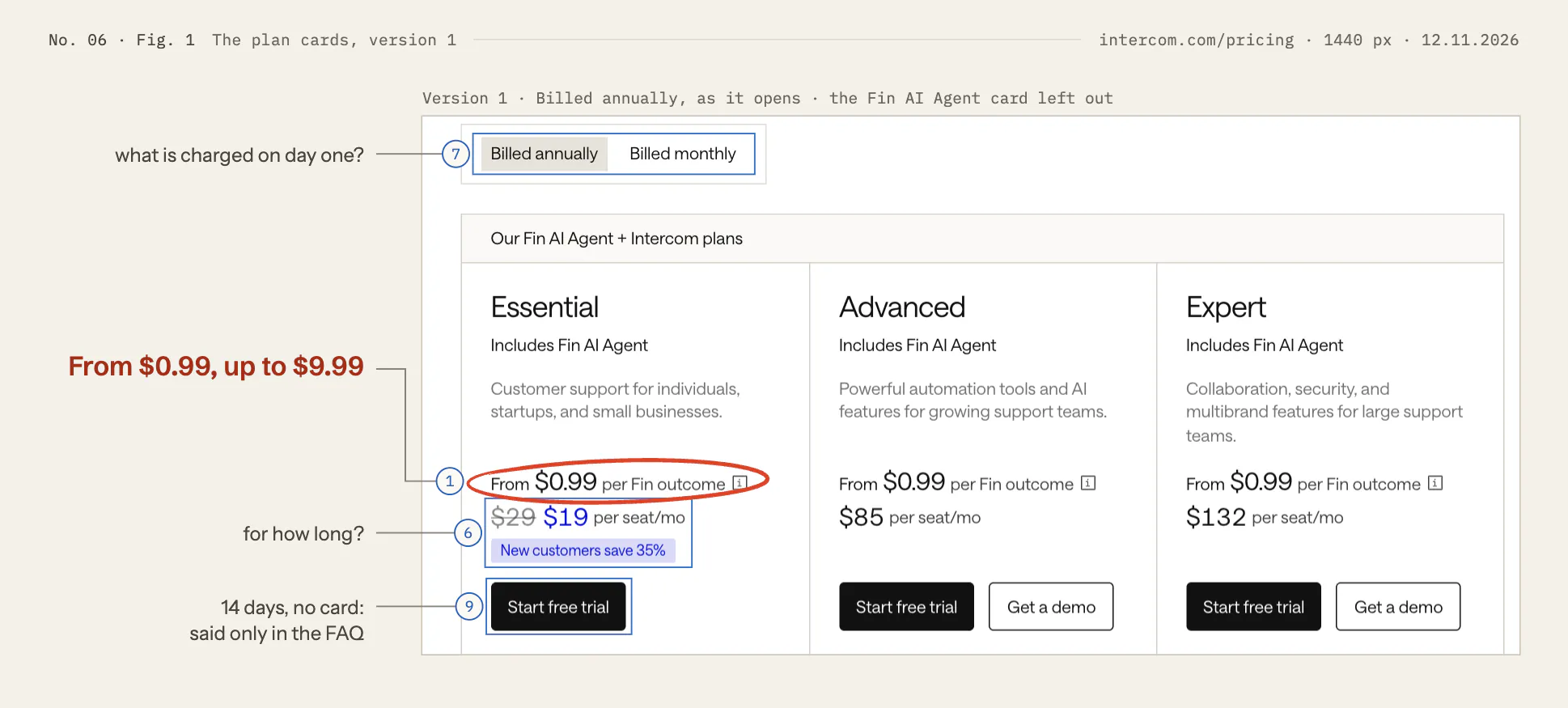
The plan cards, version 1 intercom.com/pricing · 1440 px · 12.11.2026
Changes 01: Say what a sales outcome costs where “$0.99” is said 06: Say how long the new-customer price lasts 07: Say what paying annually charges on day one 09: Put the trial’s terms by its button, and say which plan it starts
Intercom is a customer service platform from Intercom, Inc., San Francisco. Its pricing page sells three plans by the seat and its AI agent, Fin, by the outcome. On the morning of Thursday 12 November 2026 the same address served two versions of that page. I read both, at 1440 px and 390 px wide, and list here what I would change, in order.
Much of it works. Fin is charged once a conversation at most, however many questions it answers. Both versions say spending can be capped. Version 2 says in plain words when Fin costs nothing, and works a month’s bill out on the page. Eight of these changes hold on both versions. Two are things version 2 already does, and I would keep them. Each change says which.
Ten changes, in order
Say what a sales outcome costs where “$0.99” is said
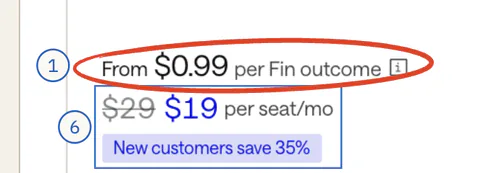 Seen in Fig. 1. Show it on the figure.From $0.99, up to $9.99
Seen, why, try
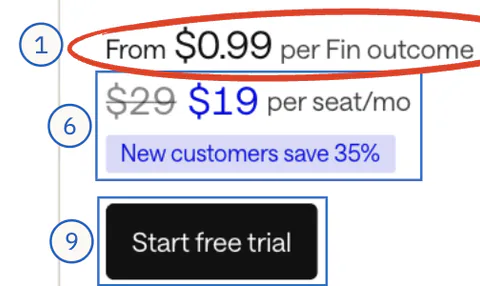
Seen. Version 1’s cards read “From $0.99 per Fin outcome” (Fig. 1). Behind the (i) beside it, four kinds of outcome are $0.99 each and a fifth, Qualification, is “$9.99 EACH” (Fig. 3). Version 2’s cards read “$0.99 per outcome”, with no “From” (Fig. 2). As that page opens it prints $0.99 six times and $9.99 nowhere. Its (i) says “Outcomes are priced at $0.99 each.” and ends “For Fin for Sales pricing, see here.” (Fig. 3), a link to a help article that gives $9.99 per Qualification (read the same morning, not shown here). On both versions the comparison table says “$9.99 per qualification on all plans” (the inset).
Why it matters. A team that turns Fin on for sales pays about ten times the printed price for the outcome it most wants, a qualified lead. On version 1 the first feature on Essential’s card is “Fin for service, sales & ecommerce” (read, not shown here), so the cheaper price is advertised beside the dearer use.
Try. One line under the price, on either version: “$0.99 per support outcome. Sales: $9.99 per qualified lead.” Version 2 already does this for voice, lower down: Fin Voice is “$1.99 per voice outcome”.
 , open it full size
Inset The comparison table: what a qualified sales lead costs intercom.com/pricing · the comparison table, both versions · 1440 px · 12.11.2026 Make the FAQ and the outcome dialog say the same thing
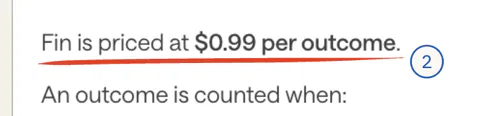 Seen in Fig. 4. Show it on the figure.one price; elsewhere, three
Seen, why, try
Seen. The FAQ is the same on both versions. It says “Fin is priced at $0.99 per outcome.” and lists three cases that count: a customer confirms the issue is resolved, “They don’t ask for more help after Fin responds”, or “Fin completes a workflow (Procedure), including handoffs” (Fig. 4). Version 1’s dialog lists five kinds of outcome at two prices. Version 2’s adds what doesn’t count, and that when a resolved conversation is reopened “The earlier outcome is refunded.” (Fig. 3). The FAQ doesn’t mention the refund. Its question sits 3,467 px below the price on version 1 and 4,133 px below it on version 2. The help article names the silent case an “assumed resolution” (the inset).
Why it matters. What counts as an outcome is the bill. A buyer who reads the FAQ and a buyer who opens the (i) come away with different rules. On the page, the rule most in the buyer’s favour, the refund, is only in version 2’s dialog.
Try. One definition, written once and used in both places: the FAQ’s plain words for what counts, version 2’s list of what doesn’t, the refund, and every price.
 , open it full size
Inset The help article: what a resolution is intercom.com/help · Fin AI Agent outcomes · 1440 px · 12.11.2026 Put Pro’s real price on its card
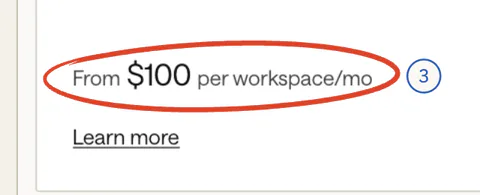 Seen in Fig. 5. Show it on the figure.then $0.20 a conversation
Seen, why, try
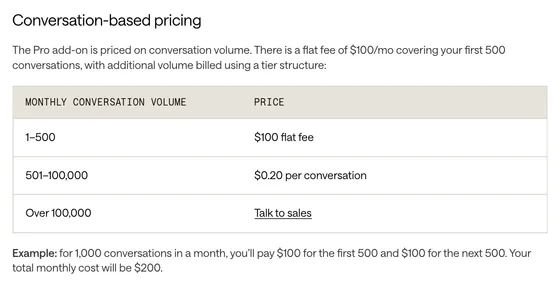
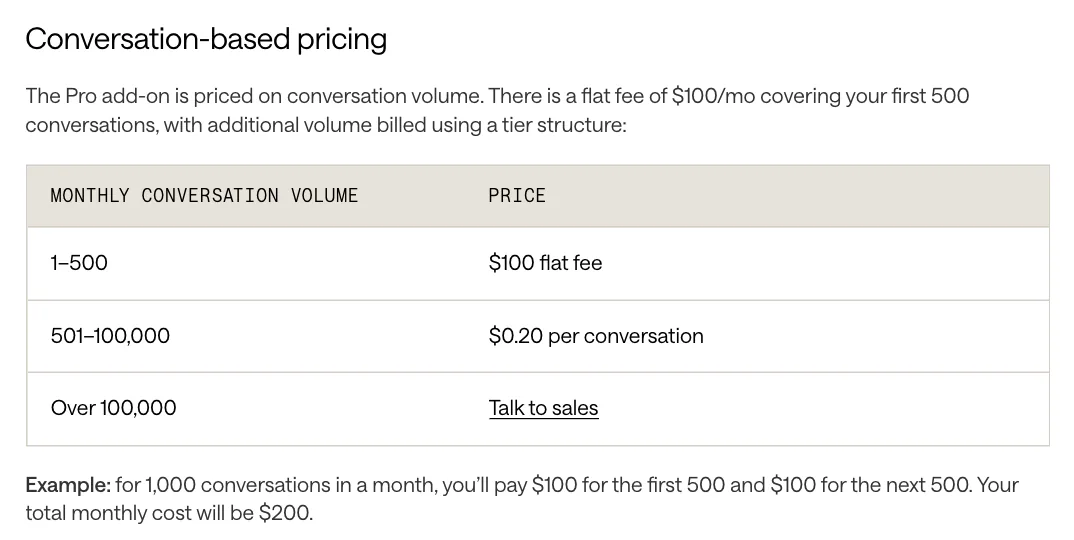
Seen. Pro is an add-on of AI features for the support team. Its card reads “From $100 per workspace/mo” on version 2 (Fig. 5) and “From $100 /mo” on version 1 (read, not shown here). On version 2, “Learn more” opens a dialog: “a flat fee of $100/mo covering your first 500 conversations”, then “$0.20 per conversation” from 501 to 100,000 (the inset). The same dialog says Pro’s agent, Operator, comes with 6,000 credits a month, and that more cost $0.01 a credit (read, not shown here). The FAQ gives the $100, the 500 conversations and the credits. It doesn’t give the $0.20. On version 1, “Learn more” is a link to a help article, which I did not read.
Why it matters. “From” is carrying most of the price. On the dialog’s own table, a team with 5,000 conversations a month pays $100 + 4,500 × $0.20 = $1,000 (the sum is mine): ten times the figure on the card, before any extra credits.
Try. On the card: “$100/mo for your first 500 conversations, then $0.20 each. 6,000 Operator credits included.” Put the dialog’s own worked example beside it.
 , open it full size
Inset Pro’s dialog: how its price grows intercom.com/pricing · version 2 · Pro, “Learn more” · 1440 px · 12.11.2026 Show every visitor the estimate
 Seen in Fig. 6. Show it on the figure.show this to everyone
Seen, why, try
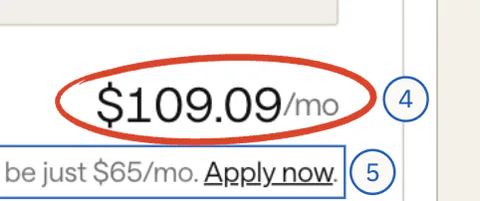
Seen. Version 2 has a box, “Get a quick cost estimate”, 794 px below the first price. As it opens: 120 conversations a month, 76% of them resolved by Fin, one Essential seat, “$109.09 /mo” (Fig. 6). Version 1 works out no sum on the page. It links to a calculator at another address, 1,581 px below the first price, and again in its first FAQ answer (read, not shown here; I did not use the calculator).
Why it matters. A price per outcome means little until it is multiplied. In the box’s own example Fin is $90.09 of the $109.09. Usage, not the seat, is most of the bill, and a visitor given version 1 can’t see that without leaving the page.
Try. Keep the box, whichever version is kept. Add two rows: sales outcomes (change 1), and Pro, whose price grows with the same conversation count (change 3).
Say what the startup offer is 93% off
 Seen in Fig. 2. Show it on the figure.93% off what?
Seen, why, try
Seen. Both versions say “Startups get 93% off” (Fig. 2; on version 1 in a band lower down, read, not shown here). The FAQ says “Up to 93% off + 1 year of Fin free”. Under version 2’s $109.09 total: “With Early Stage this would be just $65/mo.” (Fig. 6). With a second seat the total became $128.09, and the line still said $65 (read, not shown here). The programme’s own page, read the same morning, prices the helpdesk “from $65 per month” and lists what that buys: six Advanced seats, six Copilot seats, Proactive Support Plus and, for a year, 300 Fin outcomes a month.
Why it matters. $65 is about 40% off $109.09, not 93% (the sum is mine). I think the two agree once you know $65 buys a six-seat bundle, but the pricing page doesn’t say so. A small startup reading the estimate sees a far smaller saving than the headline. They also differ on size: “15 employees or fewer” here, “Fewer than 15 employees” there.
Try. “Early Stage: $65/mo in year one for six Advanced seats, Copilot and 300 Fin outcomes a month. That is 93% off list.” And one size rule, the same in both places.
Say how long the new-customer price lasts
 Seen in Fig. 1. Show it on the figure.for how long?
Seen, why, try
Seen. On Essential, $29 is struck through beside $19 per seat/mo, over “New customers save 35%” (Fig. 1; the same on version 2, Fig. 2). Billed monthly it is $39 struck through, $29, and “save 25%” (the inset). The badge is a button. Hovered, focused and clicked on both versions, it opened nothing. Version 2’s billing switch also says “Save up to 35%”, for paying annually.
Why it matters. A struck price says the higher one comes back. The page doesn’t say when: after a year, at renewal, or never. On version 2, two different savings carry the same 35%, one for being new and one for paying annually.
Try. Under the badge, the rule: for example, “for your first 12 months, then $29”. If it never ends, drop the struck price.
 , open it full size
Inset The same offer, billed monthly intercom.com/pricing · version 1 · Billed monthly · 1440 px · 12.11.2026 Say what paying annually charges on day one
 Seen in Fig. 1. Show it on the figure.what is charged on day one?
Seen, why, try
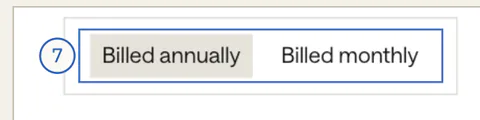
Seen. Version 1 opens on “Billed annually”, version 2 on “Pay annually” (Fig. 1 and Fig. 2). Every seat price reads “per seat/mo”. Neither version prints a yearly amount. Version 2’s estimate totals “$109.09 /mo” with its own “Pay annually” switch on (Fig. 6).
Why it matters. If annual means a year paid ahead, the first charge for one Essential seat is $19 × 12 = $228 (the sum is mine), not $19. In the estimate, a seat paid a year ahead and outcomes billed as they happen are added into one monthly figure.
Try. Beside each annual price: “$228 billed today, per seat”. In the estimate: “Seats billed yearly. Fin billed monthly, as used.”
Put Fin’s minimum on its card
 Seen in Fig. 4. Show it on the figure.said only here, and the number is left open
Seen, why, try
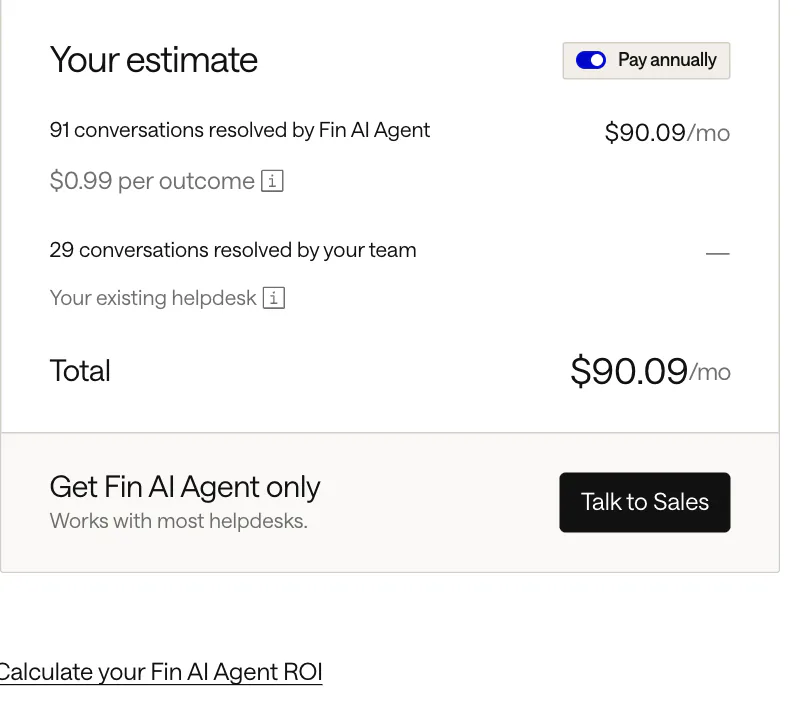
Seen. A fourth card sells Fin for a helpdesk you already have: $0.99 per outcome, and a “Contact sales” button (both versions; read, not shown here). The FAQ adds “Minimum monthly commitment applies (e.g. 50 outcomes)” (Fig. 4), 3,528 px below that card on version 1 and 4,212 px below it on version 2. With “An existing helpdesk” chosen, version 2’s estimate shows $90.09 a month and “Talk to Sales”, and no minimum (the inset).
Why it matters. A minimum is a price. Fifty outcomes would be $49.50 a month (the sum is mine), but “e.g.” leaves the real number to a sales call.
Try. On the card and in the estimate: “Minimum 50 outcomes a month ($49.50)”, with the true number.
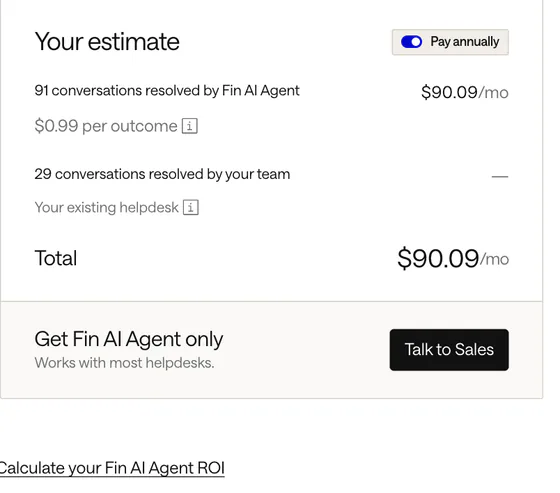 , open it full size
Inset The estimate with “An existing helpdesk” chosen intercom.com/pricing · version 2 · the estimate box · 1440 px · 12.11.2026 Put the trial’s terms by its button, and say which plan it starts
 Seen in Fig. 1. Show it on the figure.14 days, no card: said only in the FAQ
Seen, why, try
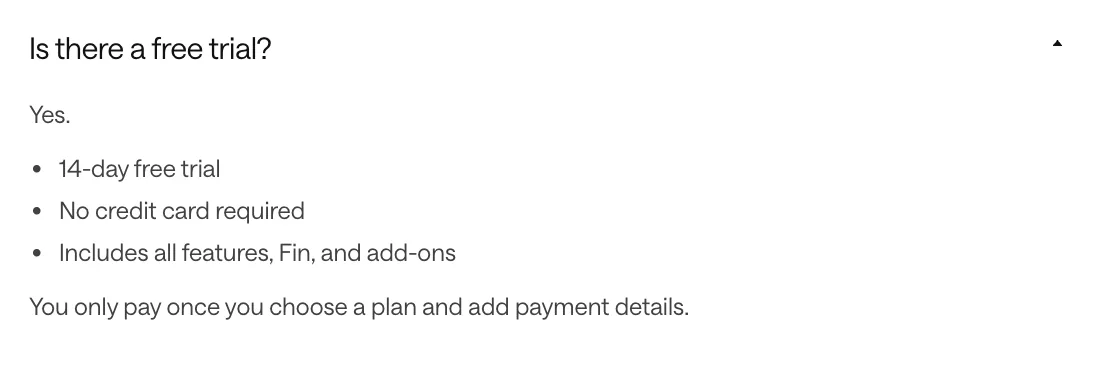
Seen. Version 1’s buttons say “Start free trial” (Fig. 1). The terms are in the FAQ, 4,043 px below: “14-day free trial”, “No credit card required” (the inset). Version 2 puts “14-day cardless free trial” under its headline (Fig. 2) and, in the estimate, “Start a 14-day Essential trial” with “No credit card required.” (Fig. 6). The link under the headline has the same address as Advanced’s button; the estimate’s button has Essential’s. The FAQ says the trial “Includes all features, Fin, and add-ons”.
Why it matters. Version 2 fixes the larger half: the terms are now where the decision is. What is left is which plan a visitor is trying, and which one they are on when the 14 days end.
Try. Keep version 2’s line and add the plan to it. If that is how it works: “14 days of everything, no card. Pick your plan at the end.”
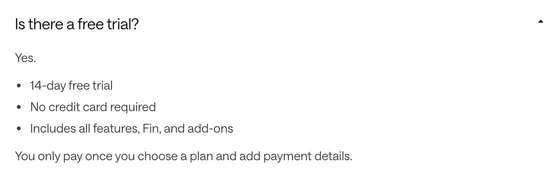 , open it full size
Inset The FAQ: “Is there a free trial?”, opened intercom.com/pricing · FAQ, both versions · 1440 px · 12.11.2026 Use one word for the person you pay for
 Seen in Fig. 5. Show it on the figure.per agent and per teammate, on one card
Seen, why, try
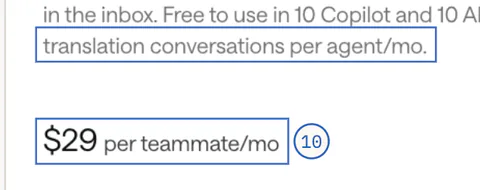
Seen. The plan cards price “per seat/mo”. Version 1’s Copilot card says “per agent/mo” (read, not shown here). Version 2’s says “$29 per teammate/mo”, under a description that ends “per agent/mo.” (Fig. 5). The FAQ says “per teammate” for plans and “per agent” for Copilot. The comparison table says “Upgrade any agent to unlimited for $35/mo” (the inset), read with annual billing on, when the card says $29.
Why it matters. Seat, agent and teammate may be one thing or three. A buyer counting heads for a quote has to guess. And for anyone paying annually, the table’s $35 disagrees with the card’s $29.
Try. One word, “seat”, wherever a person is charged for. In the table: “$29/mo billed annually, $35 billed monthly”, as the FAQ has it.
 , open it full size
Inset The comparison table: Copilot, with Pay annually on intercom.com/pricing · the comparison table, both versions · 1440 px · 12.11.2026




(01)Figures
The changes, shown on screenshots
Each change is framed and carries its number from the list above; the one that matters most in each figure is ringed or underlined in red. Each figure says which version of the page it shows. Fig. 3 and Fig. 4 show states reached with the page’s own controls: the (i) beside the price opened, and two FAQ answers opened. Each figure opens full size.
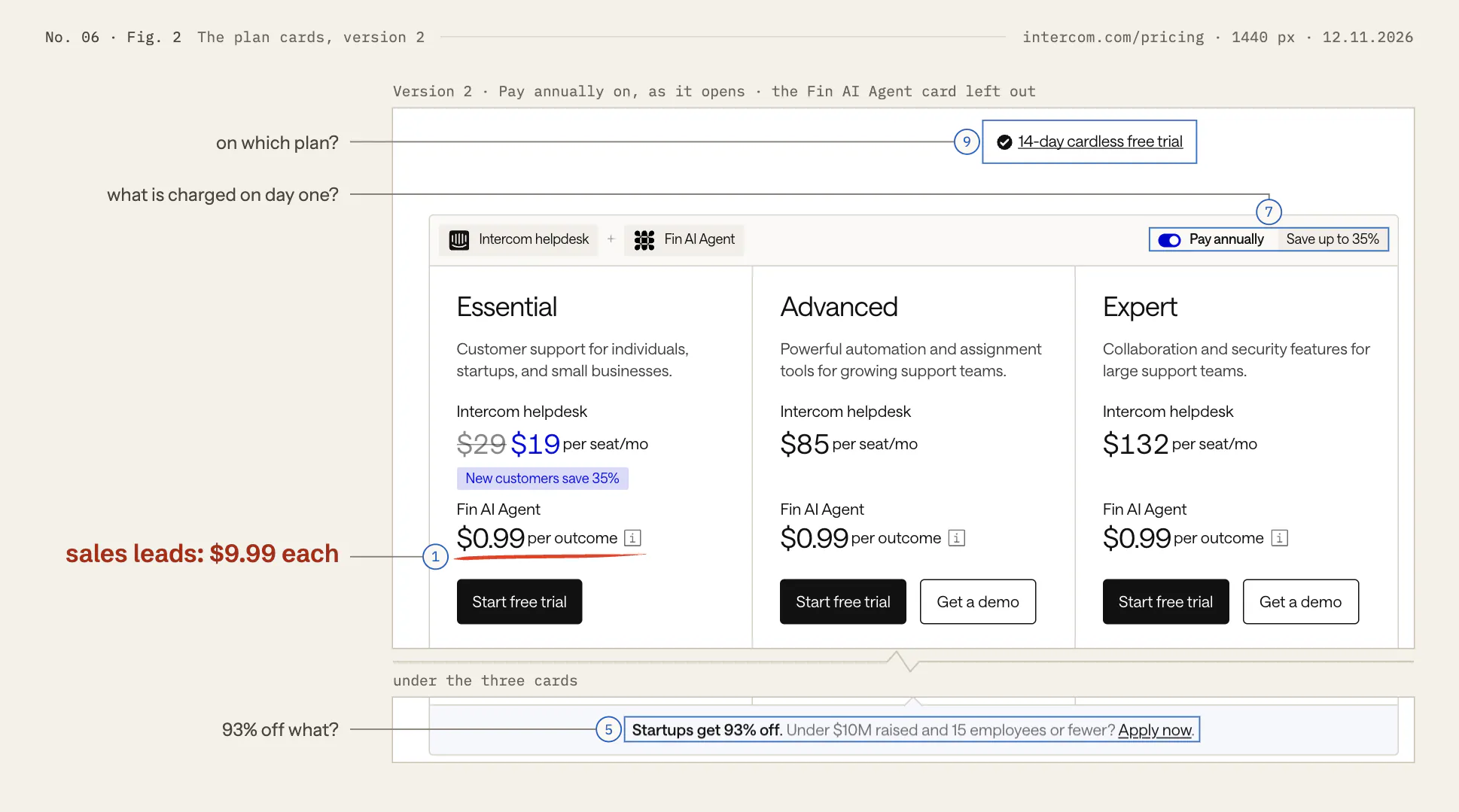
The plan cards, version 2 intercom.com/pricing · 1440 px · 12.11.2026
Changes 01: Say what a sales outcome costs where “$0.99” is said 05: Say what the startup offer is 93% off 07: Say what paying annually charges on day one 09: Put the trial’s terms by its button, and say which plan it starts
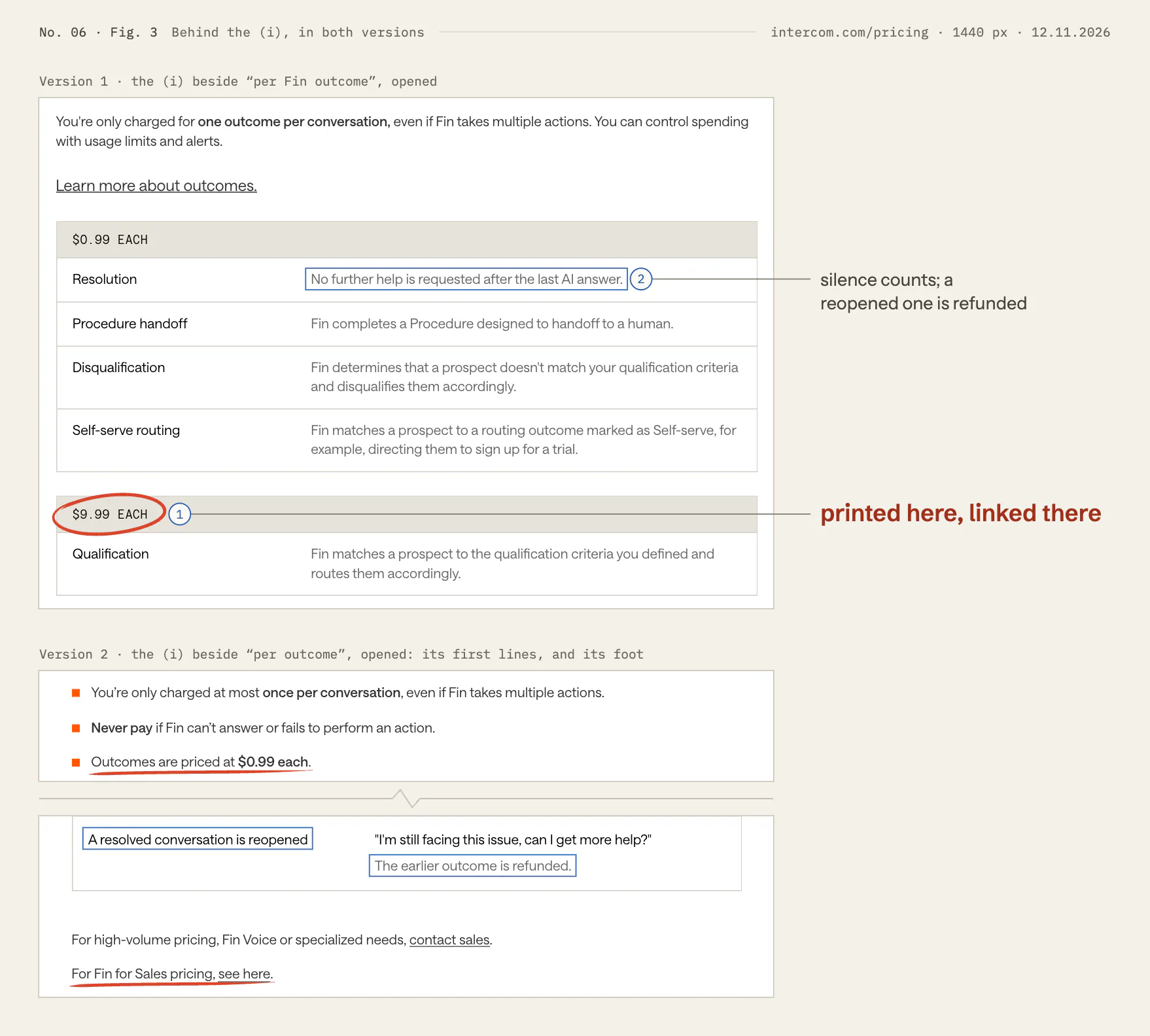
Behind the (i), in both versions intercom.com/pricing · 1440 px · 12.11.2026
Changes 01: Say what a sales outcome costs where “$0.99” is said 02: Make the FAQ and the outcome dialog say the same thing
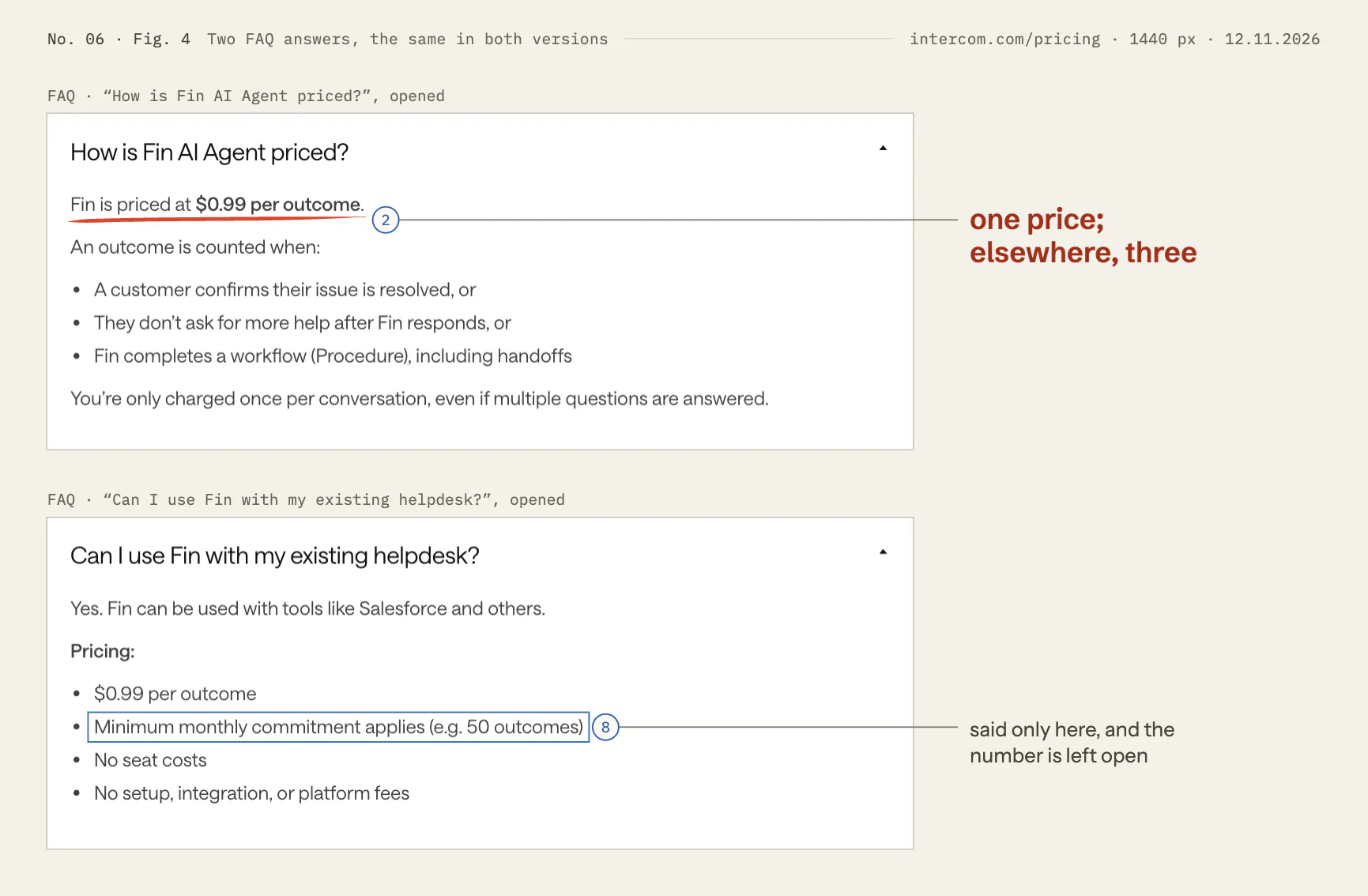
Two FAQ answers, the same in both versions intercom.com/pricing · 1440 px · 12.11.2026
Changes 02: Make the FAQ and the outcome dialog say the same thing 08: Put Fin’s minimum on its card
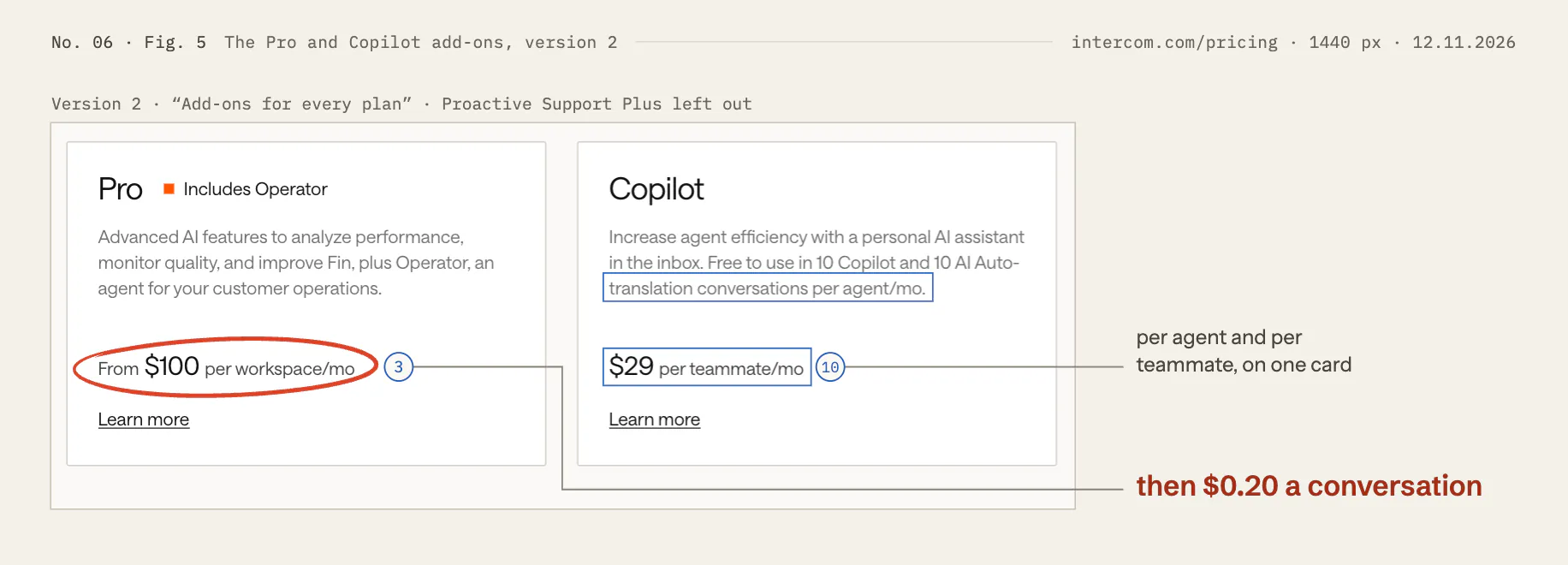
The Pro and Copilot add-ons, version 2 intercom.com/pricing · 1440 px · 12.11.2026
Changes 03: Put Pro’s real price on its card 10: Use one word for the person you pay for
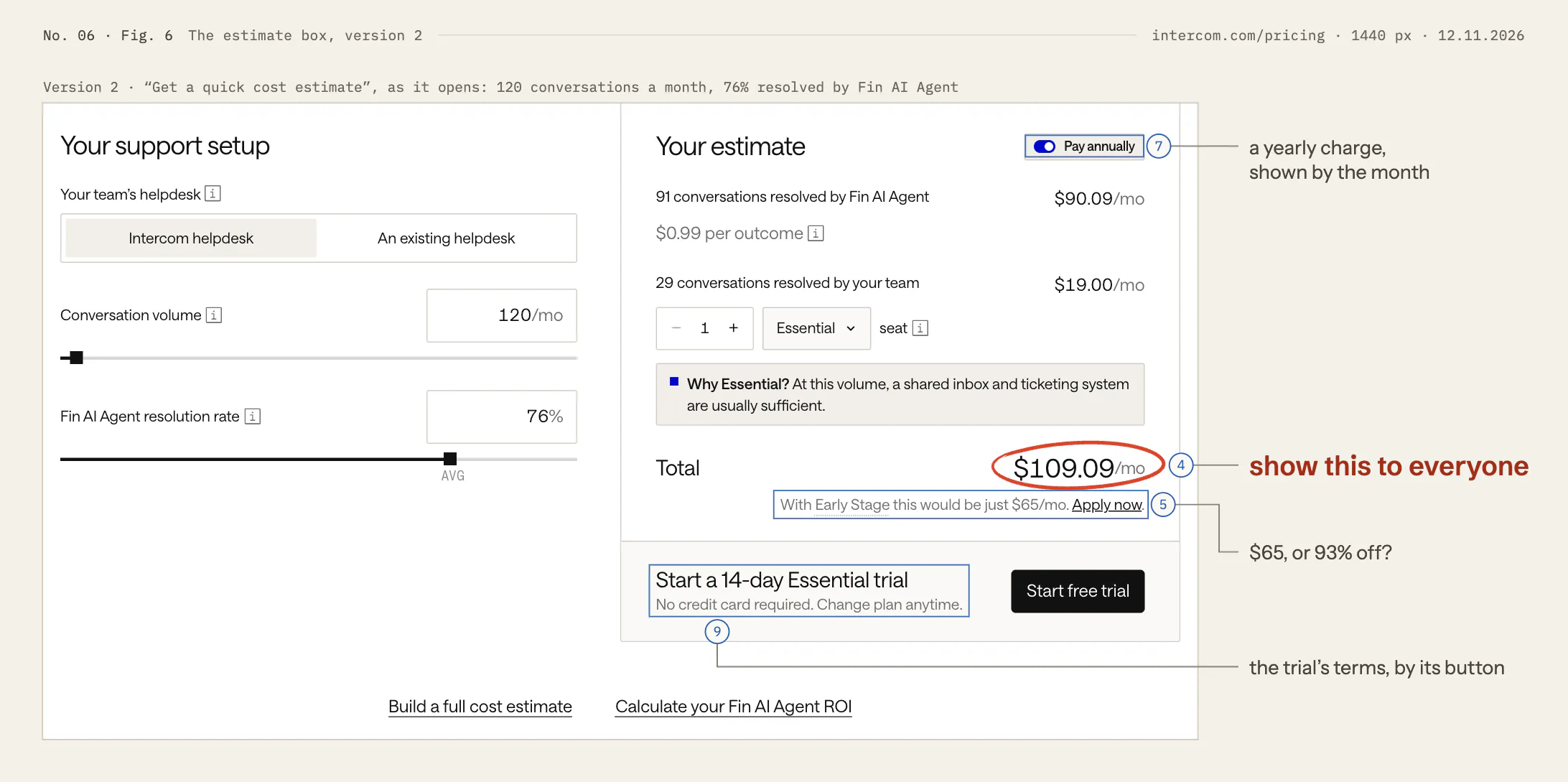
The estimate box, version 2 intercom.com/pricing · 1440 px · 12.11.2026
Changes 04: Show every visitor the estimate 05: Say what the startup offer is 93% off 07: Say what paying annually charges on day one 09: Put the trial’s terms by its button, and say which plan it starts
(02)TestsSuggested, not run
What I’d test first
The sales price beside $0.99 (change 1). Show half of new visitors today’s price line, and half the same line with “Sales: $9.99 per qualified lead” under it. Measure trials started and, among teams that later turn Fin on for sales, how many still have it on after their first full invoice. Watch trial starts as the guardrail. Agree beforehand the smallest change worth acting on, and run for at least two full weeks.
Pro’s price on its card (change 3). Show half of new visitors “From $100”, and half “$100/mo for your first 500 conversations, then $0.20 each”. Measure trials that add Pro and, later, how many keep it after the first full invoice. Watch add-on starts as the guardrail. Intercom was running a test of its own that morning, version 1 against version 2; I don’t know what it measures or how it is going. Changes 2, 5, 7 and 10 need no test: they make the page agree with itself.
(03)How it was readPublic pages only
Method and limits
- Public page only. No inside data, not affiliated.
- Two versions. On Thursday 12 November 2026, intercom.com/pricing gave a new visitor one page or another. Version 1’s headline begins “Get Fin and Intercom for a single”; version 2’s is “Intercom helpdesk plans with Fin AI Agent built in”. The page set a cookie, experiment_assignments, which named a test, pricing-page-v2, and a side: “control” with version 1, “treatment” with version 2. Of the five fresh browsers the two final sessions opened, three were given version 1 and two version 2. I set no cookie.
- What I looked at. Both versions, as a visitor who was not signed in, from India, with prices in US dollars: version 2 between 07:45 and 07:48 UTC and version 1 between 07:54 and 07:57 UTC. The same morning I read what they link to: the help articles “Fin AI Agent outcomes” and “Fin for Sales FAQs”, and the Early Stage page.
- How. Screenshots in headless Google Chrome at 1440 px and 390 px wide. A short script used the page’s own controls, as a visitor would: the billing switch, the (i) beside the price, the comparison table, “Learn more” on Pro and Copilot, the FAQ and, in version 2’s estimate box, “An existing helpdesk” and “Add a seat”. Nothing was typed. The buttons’ addresses were read, not followed.
- Measured. Every position and distance from the page’s layout, in CSS pixels. The sums ($100 + 4,500 × $0.20, $19 × 12, 50 × $0.99, and $65 against $109.09) are mine.
- What I did not do. No account, no trial, no form and no contact with Intercom. I did not use the calculator at intercom.com/pricing/calculator, or read fin.ai/pricing or the Pro and Copilot help articles. On a phone both versions carry the same lines in one column; no figure shows it.
- What I don’t know. Intercom’s traffic, conversion rates or plans; what its test measures, how long it has run or which version will be kept; and how the new-customer price, annual billing or the trial work once you are a customer. Some of these changes may already have been tried.
- Limits. The page may differ by country, by visitor and over time, and that morning it differed by visitor. The figures show each version as captured on the date above, not as the page is today. If you are given a version that differs from both, tell me and I will add a dated note here.
- Not affiliated. I have no connection with Intercom, and Intercom has not reviewed this. Intercom is a trademark of Intercom, Inc.
The record12.11.2026
- No.
- 06
- Subject
- Intercom
- Page or flow
- pricing page, intercom.com/pricing
- Region
- US
- Captured
- , at 1440 px
- Published
- Inside
- ten changes, in order · six figures · seven insets
Public pages only, as seen on the date. Not affiliated with Intercom.
Sources
- Intercom, “Intercom Pricing | Plans for every team size”, intercom.com/pricing, read on 12 November 2026 in both versions, with the dialog behind the (i) beside the price, the comparison table, version 2’s estimate box and its “Learn more” dialogs for Pro and Copilot, and all fourteen FAQ answers.
- Intercom Help, “Fin AI Agent outcomes”, intercom.com/help, read on 12 November 2026: the price of each kind of outcome, confirmed and assumed resolutions, and that a resolution is taken off the bill if the customer comes back to the same conversation.
- Intercom Help, “Fin for Sales FAQs”, intercom.com/help, read on 12 November 2026: $9.99 per Qualification, and $0.99 for the other sales outcomes.
- Intercom, “Intercom for Startups: Early Stage Program Pricing”, intercom.com/early-stage, read on 12 November 2026: from $65 a month, 93% off in the first year, what the plan includes, and who is eligible.
- Intercom, “Terms and Policies”, intercom.com/legal/terms-and-policies, read on 12 November 2026: Intercom, Inc., a Delaware corporation with offices in San Francisco.